
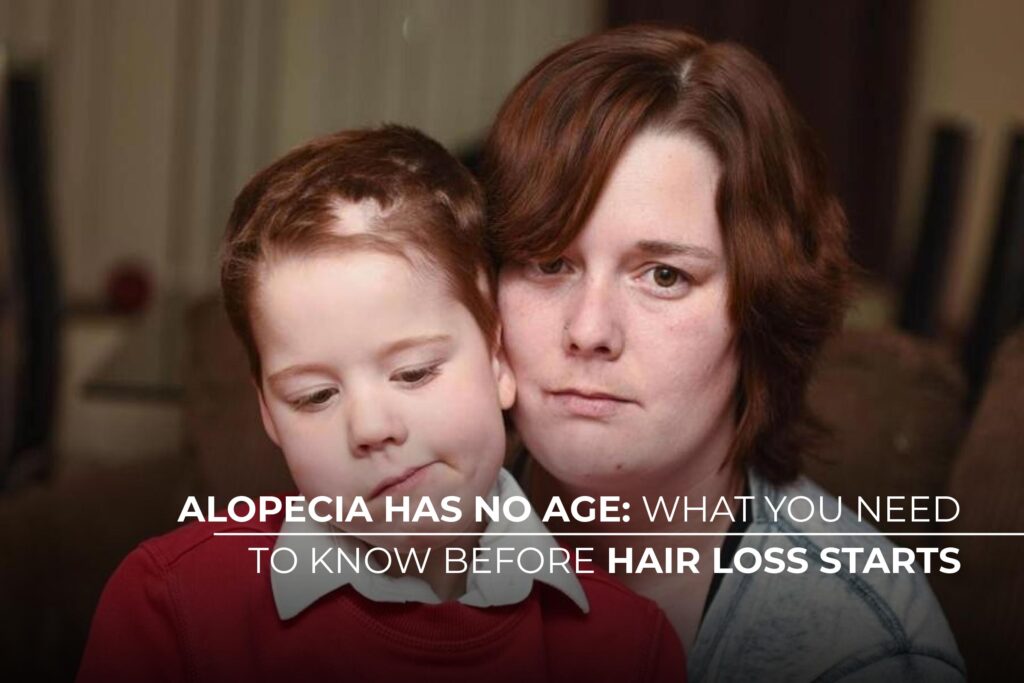
Most people picture hair loss as something that happens later in life, a gradual thinning that creeps in somewhere after 40, or a receding hairline that shows up uninvited in your 50s. But here’s what the science actually says: alopecia has no timeline. It doesn’t wait for a certain birthday, a certain gender, or a certain life stage. It shows up when it wants and for many people, that’s much earlier than anyone expects.
Understanding that hair loss can begin at virtually any age isn’t meant to be alarming. It’s meant to be empowering. Because the sooner you recognize what’s happening, the sooner you can do something about it.
What is alopecia, really?
Alopecia is a broad term that covers several types of hair loss, the most common being alopecia areata, an autoimmune condition where the immune system mistakenly attacks hair follicles, causing hair to fall out in patches. It affects roughly 2% of the global population regardless of age, sex, or ethnicity.
Other forms include androgenetic alopecia (the classic pattern hair loss most associated with aging), traction alopecia (caused by repeated tension on the hair), and telogen effluvium (triggered by stress, illness, or hormonal changes). Each has its own causes and timeline, but what they all have in common is this: none of them need your permission to start.
Alopecia at every stage of life
In your teens and twenties, hair loss often comes as a shock precisely because it feels out of place. Stress, hormonal shifts, nutritional deficiencies, and autoimmune triggers are all common culprits at this stage. The emotional weight tends to be heavier here, identity, self-image, and social confidence are all deeply tied to appearance at this age.
In your thirties and forties, pattern hair loss often becomes more visible, and many people notice changes they’d been quietly ignoring for years. This is also a common stage for postpartum hair loss, which affects a significant number of women in the months following childbirth.
In your fifties and beyond, hair thinning becomes more widespread but is often still treatable and manageable with the right approach.
There are both instant and long-term solutions when it comes to managing hair loss, and the right approach often depends on your lifestyle and goals. Treatments like minoxidil-based formulas support hair growth over time and Hair Fibers offer an immediate, natural-looking boost by making hair appear fuller in seconds.
It can start as early as age 2 and that matters
April 14 was Children with Alopecia Day, a global awareness moment dedicated to the youngest people navigating hair loss. And while it may surprise many to learn that alopecia can appear in toddlers and school-age children, the medical reality is clear: alopecia areata does not discriminate by age. For children, the challenge isn’t just physical, it’s the emotional landscape of growing up feeling visibly different. But their experience is also a powerful reminder of something important for all of us: hair loss is not a consequence of aging, of poor health choices, or of anything you did wrong. It is a condition that can affect anyone, at any point in their life.
Recognizing children with alopecia as part of the broader hair loss community matters, because it dismantles the myth that this is only an adult concern, and opens up more honest, more compassionate conversations about hair loss at every age.
Alopecia may not follow a timeline, but support, understanding, and solutions are always within reach. From medical treatments to gentle cosmetic options and emotional support systems, there are many ways to navigate hair loss at any age with confidence and care. What matters most is knowing you’re not alone, and that your experience is valid, whether it begins at 5, 25, or 55. Because at the end of the day, hair doesn’t define you… but how you choose to embrace your journey can.