
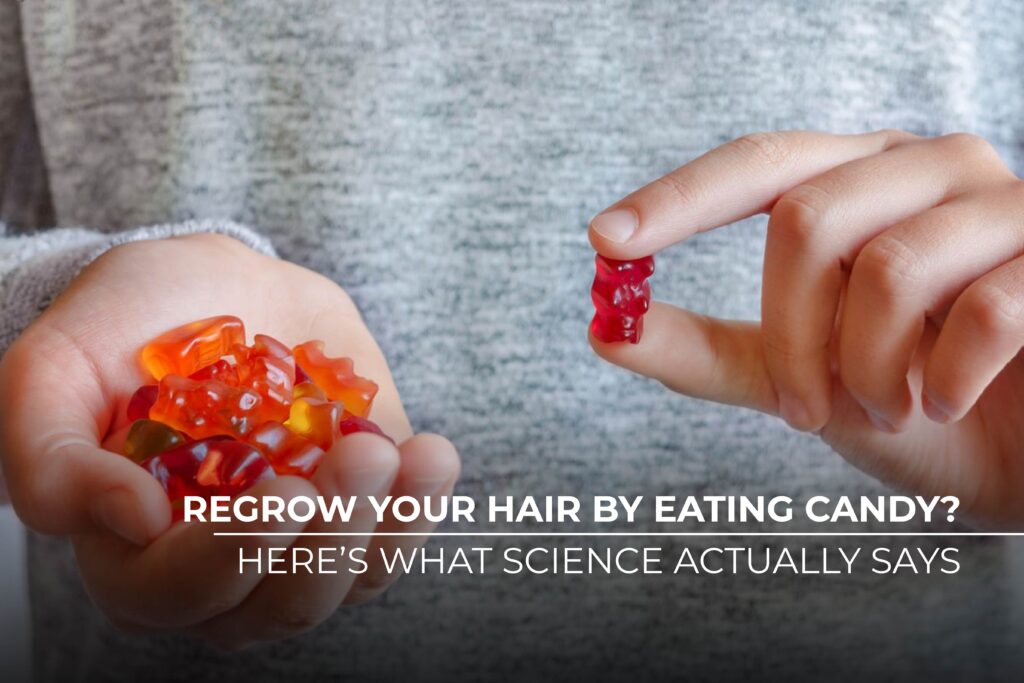
Eat something that tastes like candy… and regrow your hair?
At first glance, it feels like one of those internet myths that disappear as quickly as they trend. But recently, hair restoration physician Alan J. Bauman, Medical Director of Bauman Medical, discussed a new category of nutraceutical hair supplements formulated as gummies, and backed by clinical observation.
So no, we’re not talking about sugar-filled sweets magically reversing baldness.
We’re talking about targeted, multi-ingredient formulations designed to support hair follicle health at the cellular level, where hair growth actually begins.
Hair thinning isn’t usually caused by just one thing
One of the biggest misconceptions about hair loss is that there’s always a single trigger.
In reality, thinning hair is often influenced by multiple factors happening at the same time: hormonal shifts, inflammation, oxidative stress, declining cellular energy, and nutritional gaps.
Hair follicles are extremely active structures. They need energy and balance to stay in the growth phase. When that internal balance declines, due to stress, aging, or metabolic changes, hair can become thinner, weaker, and slower to grow.
The American Academy of Dermatology recognizes that hormones, genetics, and overall health all play a role in hair thinning. That means solutions can’t always be purely topical. Sometimes, internal support matters too.
So what are hair growth gummies actually doing?
The idea behind medically formulated hair growth gummies isn’t magic. These supplements typically combine ingredients aimed at helping:
- Maintain healthy cellular energy
- Reduce oxidative stress
- Support hormonal balance (including DHT sensitivity)
- Protect hair follicles from inflammatory stress
In small clinical observations referenced by Dr. Bauman, consistent use of multi-ingredient nutraceutical gummies was associated with improvements in hair density and reduced shedding over a few months. Not overnight, but noticeably.
Research indexed in PubMed has explored similar approaches, especially in cases where thinning is influenced by metabolic or inflammatory factors.
So, can gummies replace medical treatment?
Short answer: no.
Longer answer: they may support a broader strategy.
If hair loss is strongly genetic or driven by high DHT sensitivity, supplements alone are rarely enough. Treatments like minoxidil or physician-guided therapy may still be necessary. And as the Mayo Clinic advises, supplements should always be reviewed with a healthcare provider, especially if you’re taking other medications.
Hair growth gummies can be part of the solution, but they are not the whole solution.
The bigger reality about hair growth
Hair restoration takes time. Even when follicles are supported internally, visible change requires months because hair grows slowly and cycles gradually.
That’s why many people combine long-term biological strategies with cosmetic solutions in the meantime.
For example, Hairatin Hair Fibers are ammonia-free and suitable for hair transplant patients, minoxidil users, chemotherapy patients, and people with early hair loss or alopecia. They don’t influence follicle biology, but they instantly enhance the appearance of density while internal strategies do their work.
Two different approaches, one shared goal: healthier-looking hair.
“Regrow your hair by eating candy” sounds absurd at first.
But when that “candy” is actually a carefully formulated supplement designed to support follicle health from within, the claim becomes less outrageous and more nuanced.
There’s no magic sweet, but there is science behind supporting your hair in smarter ways.